For the creation of detailed 3D assets It was required expensive software, as well as hours of manual work. Designers had to carefully sculpt geometric shapes, refine texture and then optimize their models before they could be made. Today artificial intelligence is transforming that process dramatically. With modern tools, it is now possible to create the 3D model of an image quickly, making 3D design easier for business professionals, experts and even beginners.
3D AI Studio demonstrates how advanced the technology has come and offers a simplified set of tools to aid creators to go from concept to model in a fraction of the time.
There is an increasing demand for speedier 3D creation
The need for high-quality 3D content is growing across various sectors. Realistic visual assets are essential in presenting ideas and attracting customers across many fields such as gaming, product design and film, architecture and ecommerce. In order to meet ever-growing demand, teams are looking for quicker methods to create models without compromising quality.
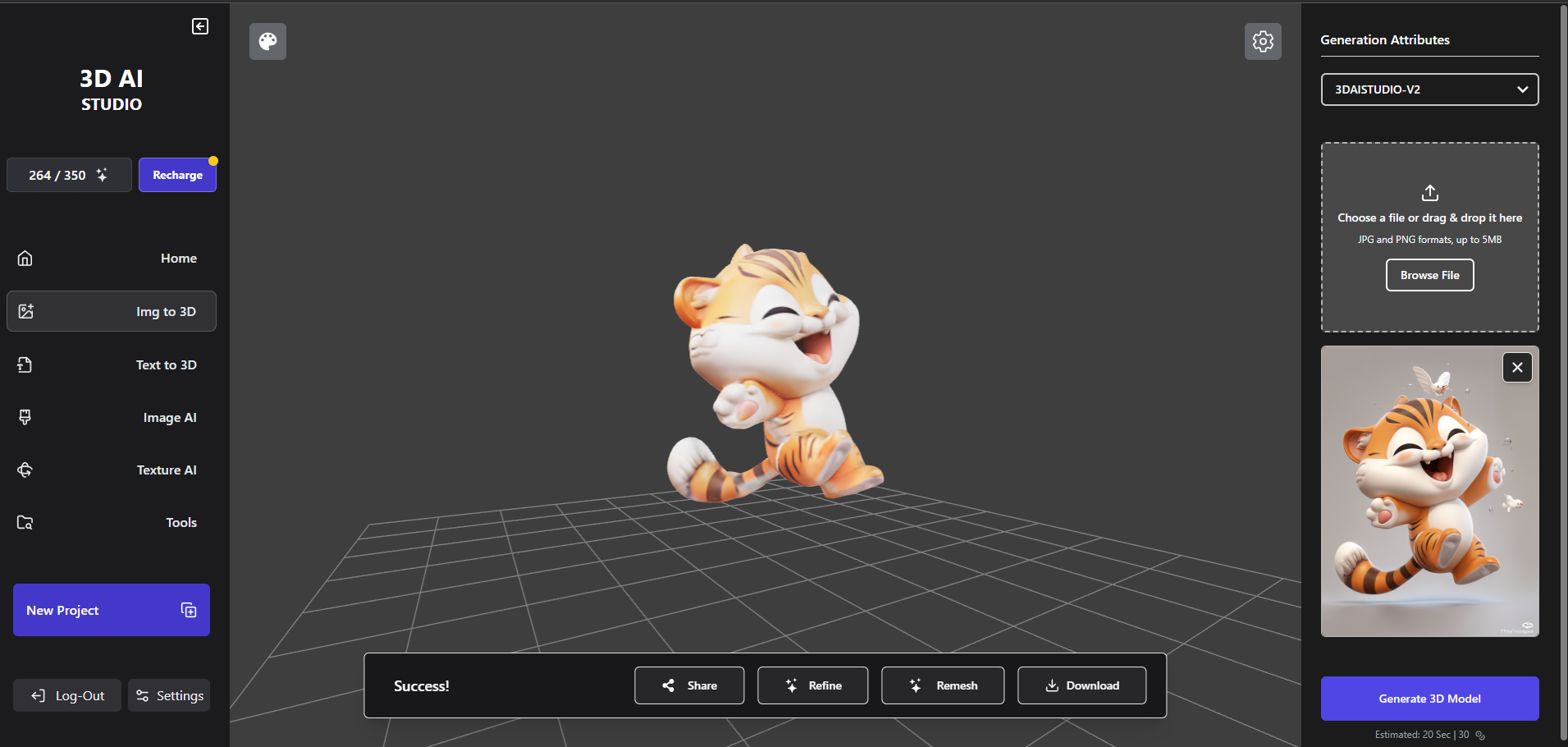
This is where image to 3D model tools for free and AI-powered workflows can play a key role. Instead of utilizing complex modeling software creating an image, the creators upload a picture and let AI look at the edges, shapes as well as the textures and aspects. The software converts the visual information into a 3D structure.
This allows for greater experiments and decreases the amount of time needed to build assets.
How Photo-to-3D Technology Work
Artificial intelligence examines images in great detail before the 3D model is created. It detects patterns, predict depth and recreate the object in 3D. The models are developed with sophisticated algorithms that have been trained on huge data sets.
The technology can be utilized for rapid prototyping. Designers can take a photograph of the concept sketch or physical object, and then transform the image into a digital model to allow for further refinement. Developers can create placeholder assets that allow users to quickly test layouts and environments without investing in intricate modeling.
The tools on platforms like 3D AI Studio can automate steps like texturing and mesh optimizing, leading to the final product that is appropriate for use.
Businesses and creators will benefit from these benefits.
One of the biggest advantages of picture to 3D model technology is accessibility. AI-powered tools enable greater involvement within 3D design. Traditional modeling demands years of expertise.
Efficiency is another key advantage. Automated processing of retopology, texture generation as well as other tasks that are repetitive eliminated. This lets creators focus more on design and creativity rather than technical processes. Faster production cycles result in a quicker delivery of the project and less expense.
The marketing team is able to create visual content faster, while educators are able to create interactive learning tools, while product designers can demonstrate prototypes earlier in the development process.
Streamlined Workflows with Flexible Export Options
Modern AI-powered platforms do more than just generate models, they also assist in managing them. Asset libraries let users store and organize projects in a structured way which makes it easier to find files and maintain various versions.
It is also crucial to be compatible. Exporting 3D models created from an image to widely-used formats allows for seamless integration with 3D printing, rendering and game engines. The flexibility of the generated files allows them to be used in a range of professional workflows.
AI-Driven 3D Design A Future Perspective
The capabilities of 3D creation are growing as the artificial intelligence advances. Future software should be able to create complex models and environments in addition to automating further steps in the production process.
Platforms like 3D AI Studio will continue to improve and offer creators more control, flexibility and speed when creating digital assets.
Conclusion
The capability to transform images into real-looking digital objects transforms the process of designing. Tools that allow for image conversion to 3D models with no workflows can transform a photograph into a 3D model, or even a photo into 3D.
As technology advances, generating 3D models from image files 3D model from images is expected to become an essential component of modern design. It will help creators bring ideas to life more quickly and with fewer restrictions than ever before.








Why Image-Based 3D Modeling Is Becoming A Valuable Tool For Visualization And Prototyping
For the creation of detailed 3D assets It was required expensive software, as well as hours of manual work. Designers had to carefully sculpt geometric shapes, refine texture and then optimize their models before they could be made. Today artificial intelligence is transforming that process dramatically. With modern tools, it is now possible to create the 3D model of an image quickly, making 3D design easier for business professionals, experts and even beginners.
3D AI Studio demonstrates how advanced the technology has come and offers a simplified set of tools to aid creators to go from concept to model in a fraction of the time.
There is an increasing demand for speedier 3D creation
The need for high-quality 3D content is growing across various sectors. Realistic visual assets are essential in presenting ideas and attracting customers across many fields such as gaming, product design and film, architecture and ecommerce. In order to meet ever-growing demand, teams are looking for quicker methods to create models without compromising quality.
This is where image to 3D model tools for free and AI-powered workflows can play a key role. Instead of utilizing complex modeling software creating an image, the creators upload a picture and let AI look at the edges, shapes as well as the textures and aspects. The software converts the visual information into a 3D structure.
This allows for greater experiments and decreases the amount of time needed to build assets.
How Photo-to-3D Technology Work
Artificial intelligence examines images in great detail before the 3D model is created. It detects patterns, predict depth and recreate the object in 3D. The models are developed with sophisticated algorithms that have been trained on huge data sets.
The technology can be utilized for rapid prototyping. Designers can take a photograph of the concept sketch or physical object, and then transform the image into a digital model to allow for further refinement. Developers can create placeholder assets that allow users to quickly test layouts and environments without investing in intricate modeling.
The tools on platforms like 3D AI Studio can automate steps like texturing and mesh optimizing, leading to the final product that is appropriate for use.
Businesses and creators will benefit from these benefits.
One of the biggest advantages of picture to 3D model technology is accessibility. AI-powered tools enable greater involvement within 3D design. Traditional modeling demands years of expertise.
Efficiency is another key advantage. Automated processing of retopology, texture generation as well as other tasks that are repetitive eliminated. This lets creators focus more on design and creativity rather than technical processes. Faster production cycles result in a quicker delivery of the project and less expense.
The marketing team is able to create visual content faster, while educators are able to create interactive learning tools, while product designers can demonstrate prototypes earlier in the development process.
Streamlined Workflows with Flexible Export Options
Modern AI-powered platforms do more than just generate models, they also assist in managing them. Asset libraries let users store and organize projects in a structured way which makes it easier to find files and maintain various versions.
It is also crucial to be compatible. Exporting 3D models created from an image to widely-used formats allows for seamless integration with 3D printing, rendering and game engines. The flexibility of the generated files allows them to be used in a range of professional workflows.
AI-Driven 3D Design A Future Perspective
The capabilities of 3D creation are growing as the artificial intelligence advances. Future software should be able to create complex models and environments in addition to automating further steps in the production process.
Platforms like 3D AI Studio will continue to improve and offer creators more control, flexibility and speed when creating digital assets.
Conclusion
The capability to transform images into real-looking digital objects transforms the process of designing. Tools that allow for image conversion to 3D models with no workflows can transform a photograph into a 3D model, or even a photo into 3D.
As technology advances, generating 3D models from image files 3D model from images is expected to become an essential component of modern design. It will help creators bring ideas to life more quickly and with fewer restrictions than ever before.
Newsletter
Recent News
Pump Starts, Wet-Well Levels, and Peak Demand: Understanding Real Pump Station Operation
The Walk to the Restroom Is Part of Park Design Too
When Business Income Makes Divorce Finances Harder to Understand
A Bonus, Business Distribution, and Salary Don’t Always Tell the Same Income Story
When a Company’s Reported Profit Doesn’t Tell You What the Business Really Earns
Why Successful Pump Stations Begin With Site-Specific Engineering